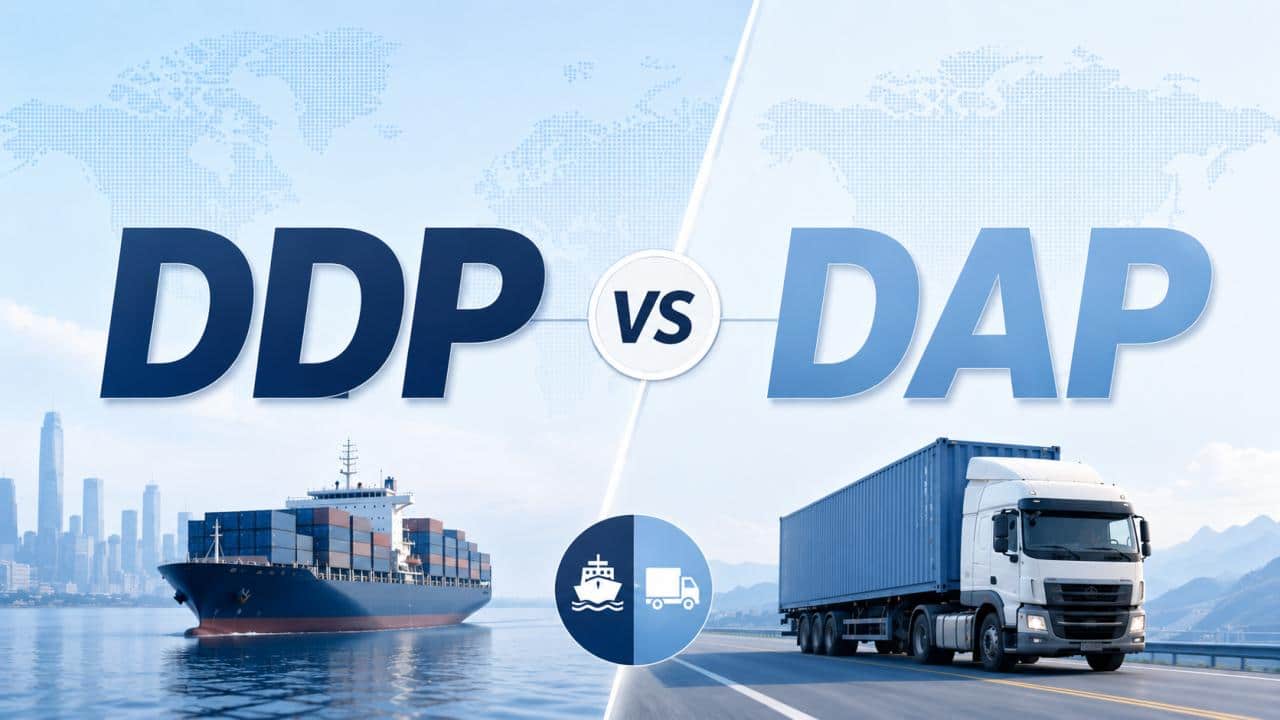
DDP and DAP are two widely used Incoterms that determine how responsibilities, costs, and risks are shared between buyers and sellers in international trade. When shipping from China to Latin America, choosing between DDP and DAP can directly affect your customs clearance process, total landed costs, and overall profitability.
In this guide, you’ll learn the key differences between DDP and DAP, how each option affects your responsibilities as an importer, and which Incoterm may be a better fit for your shipments from China to Latin America.
DDP vs DAP: Choose the Right Incoterms for Latin America Shipments
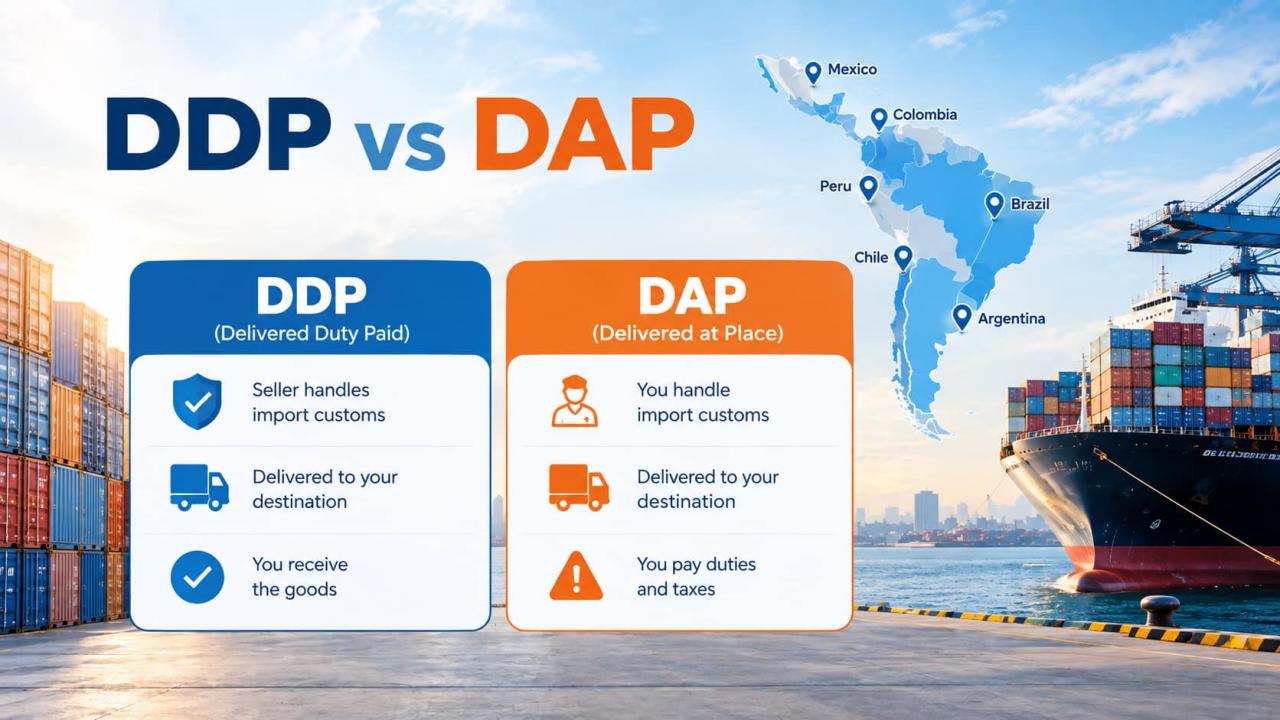
For shipments from China to Latin America, choosing the right Incoterm can significantly impact your import process.
Countries such as Peru, Chile, Mexico, Colombia, Brazil, and Argentina have different customs regulations, tax systems, and import requirements.
Choosing the wrong shipping term may result in:
- Unexpected import costs
- Customs clearance delays
- Additional storage or port charges
- Difficulties receiving your goods
The main difference between DDP and DAP is who takes responsibility after the goods arrive at the destination country — especially for import customs clearance, duties, and taxes.
What Does DDP Mean in International Shipping?
DDP (Delivered Duty Paid) means that the seller takes responsibility for all costs, risks, and responsibilities from the point of shipment until you receive the goods. This includes export customs clearance, international transportation, import customs clearance, payment of all import duties and taxes, and final delivery to your specified address.
When you choose DDP:
- You avoid handling complicated import procedures yourself.
- Duties, VAT, and other applicable taxes are already included.
- You have a clearer understanding of your total landed cost.
- You reduce the need to coordinate with a local customs broker.
- Your goods are delivered directly to your specified address.
What Does DAP Mean in International Shipping?
DAP (Delivered at Place) means that the seller is responsible for transporting the goods to your specified destination, such as the door of your warehouse, and bears the costs and risks during transportation. Once the goods arrive at the destination, the responsibility for import customs clearance and payment of duties and taxes transfers to you.
When you choose DAP:
- You handle import customs clearance.
- You pay import duties, VAT, and other applicable taxes.
- You bear the risks and potential delays during customs clearance.
- You arrange local customs support when required.
Why is DDP Shipping from China to Latin America popular?
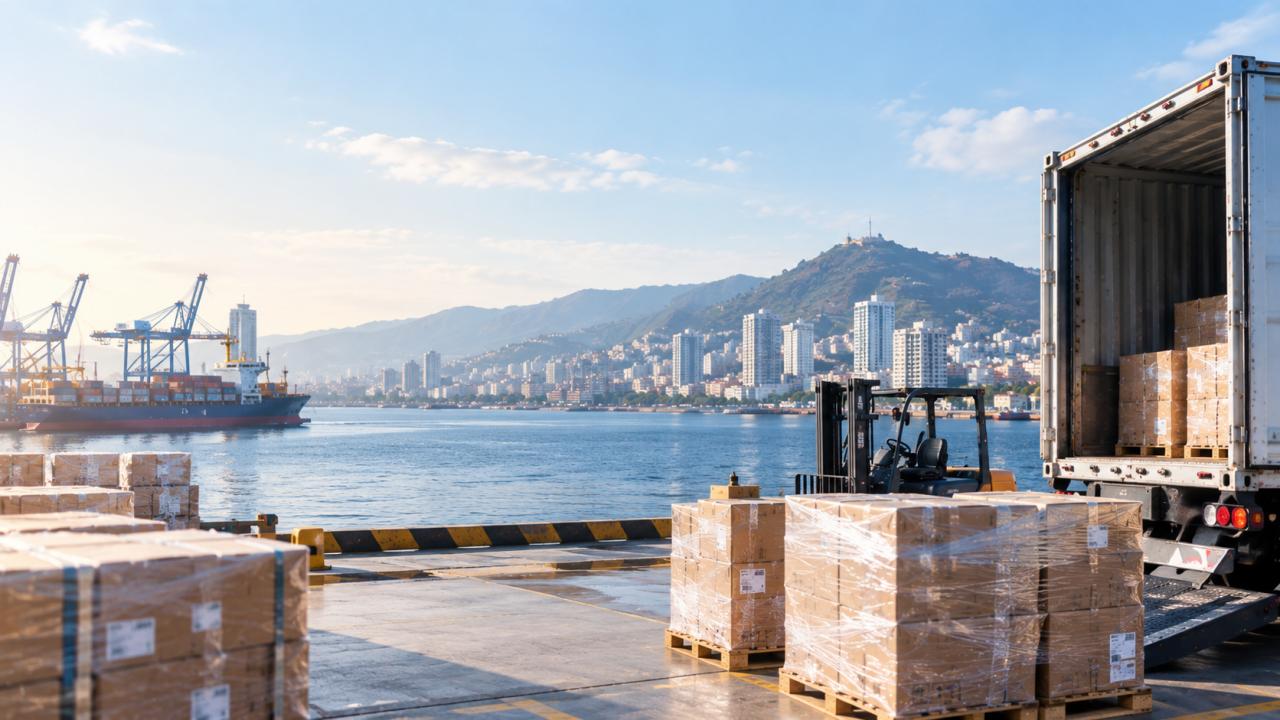
Many Latin American businesses import products from China but face challenges after the goods arrive at the destination country.
Unlike international transportation, customs clearance depends heavily on local regulations.
For example:
- Brazil has complex import procedures and requires specific importer registration systems such as RADAR.
- Mexico requires tax identification, such as RFC for many import activities.
- Chile, Peru, Colombia, and other markets also have their own documentation and customs requirements.
For companies without local import experience, managing these procedures can create unnecessary risks. However, DDP simplifies this process by providing a more complete shipping solution from China to your final destination.
Simplifying Import Customs Clearance
If you choose DAP, you are responsible for handling these customs clearance procedures yourself. This means:
- You need to have the necessary import qualifications in the destination country or work with a qualified local agent.
- You need to understand local customs procedures and documentation requirements.
- You are responsible for any additional costs caused by customs clearance delays, such as storage charges and demurrage.
When you choose DDP, the seller or the seller’s freight forwarding agent handles these customs clearance procedures for you. You do not need to obtain local import qualifications in Latin America or deal with complicated customs procedures yourself. Once your goods arrive at your specified address, you simply receive them.
Avoiding Unexpected Duties and Local Charges
One of the biggest differences between DDP and DAP is cost predictability.
A DAP quote may look cheaper at first because it usually excludes import duties, taxes, and destination customs clearance costs.
However, when your shipment arrives in Latin America, you may still need to pay additional charges, including:
- Port handling charges
- Customs clearance fees
- Storage charges
- Documentation fees
- Import duties and taxes
These additional costs can make your final landed cost much higher than the initial DAP quote.
Tariffs and taxes also vary significantly across Latin American countries and are subject to regulatory changes. Here are some examples from major markets:
| Country | Tariff Characteristics |
| Brazil | Import Tax (II) + VAT (ICMS 17%-20%) + federal taxes (PIS/COFINS), with the combined tax burden potentially reaching 60%-76% |
| Mexico | Average MFN tariff of approximately 7%, plus 16% VAT; since April 2026, more than 185 tariff codes have been subject to additional tariffs of 5%-35%; without an RFC tax ID, a 36% tax withholding may apply |
| Chile | Standard tariff of 6%, but most Chinese goods may qualify for duty-free treatment with the required FTA documentation; plus 19% VAT |
| Argentina | Import license approval can take 45-90 days, with policies subject to frequent changes |
When you choose DAP, you need to calculate these costs yourself and prepare for possible changes in customs requirements.
When you choose DDP, the shipping solution includes import-related costs according to the agreed terms. You can understand your expected landed cost before shipment instead of discovering unexpected charges after arrival.
Supporting Importers Without Local Import Experience
Many buyers importing from China to Latin America are small and medium-sized importers, cross-border e-commerce sellers, or first-time importers. You may not have the necessary local import qualifications, be unfamiliar with local customs procedures, or face communication difficulties if you do not speak Spanish or Portuguese.
For you, managing DAP can be challenging:
- Without a local tax ID such as RFC, NIT, or RUT, you may not be able to complete customs clearance.
- If you are unfamiliar with local customs systems such as Brazil’s Siscomex, incorrect declarations may result in your goods being held.
- Language barriers may make it difficult for you to communicate with customs authorities.
- If you are unfamiliar with local regulations, you may miscalculate or incorrectly pay duties and taxes, potentially resulting in penalties.
We are experienced in serving small and medium-sized importers with limited or no previous import experience in Latin America. With our DDP shipping service:
- Before shipment: You only need to provide your cargo details and delivery address. We help you confirm whether your goods can be shipped and what special documents may be required.
- During transportation: We track your shipment throughout the process and proactively update you on its status.
- During customs clearance: We handle the customs clearance procedures for you, so you do not need to deal with them yourself.
- After customs clearance: Your goods are delivered directly to your specified address. You only need to receive and sign for them.
DDP VS DAP: What is the Difference?
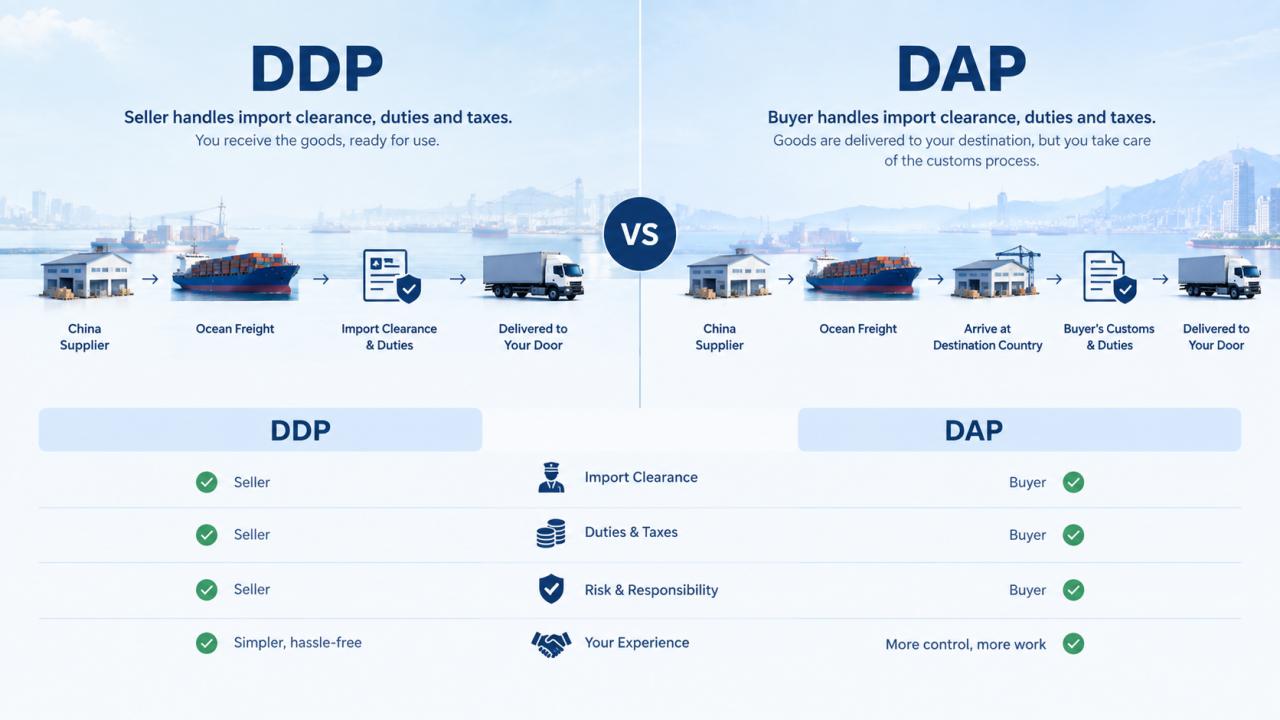
The main difference between DDP and DAP is who is responsible for import customs clearance, duties, taxes, and related costs at the destination country.
The following comparison table shows the key differences in responsibilities, costs, and risks between DDP and DAP.
| Cost Item | DDP (Delivered Duty Paid) | DAP (Delivered At Place) |
| Product Cost | Buyer | Buyer |
| Export Packaging | Seller | Seller |
| Pickup from Supplier in China | Seller | Seller |
| Export Customs Clearance (China) | Seller | Seller |
| Origin Local Charges | Seller | Seller |
| International Freight (Sea/Air) | Seller | Seller |
| Cargo Insurance | Optional (Usually Buyer/Seller Agreement) | Optional (Usually Buyer/Seller Agreement) |
| Destination Port / Airport Handling | Usually Seller (According to Agreement) | Usually Buyer |
| Import Customs Clearance | Seller | Buyer |
| Customs Broker Fees | Seller | Buyer |
| Import Duties | Seller | Buyer |
| VAT / GST / Other Import Taxes | Seller | Buyer |
| Customs Inspection Fees | Seller (If Included in DDP Agreement) | Buyer |
| Storage / Demurrage Caused by Customs Delay | Seller (According to Agreement) | Buyer |
| Local Delivery to Final Address | Seller | Seller (After Import Clearance) |
| Unloading at Final Destination | Buyer | Buyer |
If you want a simple and hassle-free shipping solution, DDP is usually more suitable.If you have an experienced import team, DAP may offer you more flexibility.
DDP vs DAP Cost Comparison: Which One Provides Better Cost Control?
The theoretical transportation cost under DAP may be lower because the seller does not need to include import duties and customs clearance costs in the quote. However, the final total cost under DAP is more difficult for you to control.
Under DAP, you need to deal with:
- Destination customs clearance fees
- Import duties, which vary by country and may reach 35%-60%+
- VAT, such as 16% in Mexico and 19% in Chile
- Potential demurrage and storage charges if customs clearance is delayed
- Potential penalties if your customs declaration is incorrect
These costs may be difficult for you to estimate accurately when you place your order. By the time you receive the final bill, your actual cost may be much higher than expected.
Is DDP More Expensive Than DAP?
Usually, yes. DDP quotes are generally higher than DAP quotes because DDP includes import duties, VAT, customs clearance fees, and other costs that are not included under DAP.
But the problem is that the lower price of DAP can be misleading. Under DAP, the additional costs you need to pay yourself may add up to more than the premium you pay for DDP.
GWT provides both DDP and DAP quotes so you can clearly compare the total costs of both options. We will specify what is included in the DDP quote and what additional costs you need to cover under DAP, helping you make the most economical decision.
Why Does DDP Provide More Predictable Landed Costs?
“Landed cost” refers to the total cost required to get your goods from the supplier to your hands. This includes the product cost, freight, insurance, duties, taxes, customs clearance fees, delivery charges, and all other related costs.
This is important for your pricing, profit forecasting, and cash flow management. You know exactly where every dollar is spent and can accurately calculate the profit margin of your shipment.
Our DDP quote includes all landed costs, from the factory in China to your warehouse in Latin America. With all costs included, you can accurately calculate your costs and profits without having to set aside extra funds for unexpected charges.
For cross-border e-commerce sellers, this means you can set your prices more accurately and forecast your profits more precisely.
DDP vs DAP: Which Incoterm Should You Choose?
The right Incoterm depends on your import experience, local resources, and how much control you want over the customs process.
When Should You Choose DDP Shipping?
DDP is ideal for importers who want a simple, predictable, and hassle-free shipping solution from China to Latin America.
| Your Situation | Why Choose DDP Shipping? |
| First-time importer from China | No import experience required; avoid complex customs procedures. |
| No local import qualifications | No need to handle import registration or customs processes yourself. |
| High-value or sensitive products | Better cost control with duties, taxes, and delivery included. |
| Complex customs requirements | Professional support with documents, clearance, and compliance. |
| No local customs resources | One-stop solution from China shipping to final delivery. |
| E-commerce sellers or small businesses | Door-to-door delivery without building a local logistics network. |
When Should You Choose DAP Shipping?
DAP is suitable for experienced importers with local customs knowledge and import capabilities.
| Your Situation | Why Choose DAP Shipping? |
| Experienced import team | Manage customs clearance and local procedures independently. |
| Existing import qualifications | Use your own importer registration and customs broker. |
| Products with FTA benefits | Control import process to maximize tariff advantages. |
| Familiar with local regulations | Better control over customs timing and costs. |
| Want full import control | Manage taxes, clearance, and local arrangements directly. |
Frequently Asked Questions About DDP vs DAP
Is DDP Better Than DAP for Importing From China?
For the Latin American market, DDP is usually the better choice. The complexity of customs clearance, changing tariff policies, and local import requirements make the advantages of DDP particularly clear. You do not need to deal with complicated customs procedures or take on the risk of unexpected charges, while your landed cost is much easier to control.
Of course, if you have an experienced import team and the necessary import qualifications in Latin America, DAP can also be a suitable option. But for most importers, the time and risk savings offered by DDP can outweigh the additional cost.
Does DDP Include Customs Clearance?
Yes—but only when you choose DDP. Under DDP, the seller or the seller’s logistics provider handles the customs clearance as the Importer of Record (IOR), so you do not need to have import qualifications or an import license in the destination country.
If you choose DAP, you need to have the necessary import qualifications in the destination country, such as RADAR registration in Brazil, an RFC tax ID in Mexico, or IOR registration in the Dominican Republic, or you need to appoint a qualified local agent.
Can I Import From China Without an Import License?
Yes—but only when you choose DDP. Under DDP, the seller or the seller’s logistics provider handles the customs clearance as the Importer of Record (IOR), so you do not need to have import qualifications or an import license in the destination country.
If you choose DAP, you need to have the necessary import qualifications in the destination country, such as RADAR registration in Brazil, an RFC tax ID in Mexico, or IOR registration in the Dominican Republic, or you need to appoint a qualified local agent.
What Is the Best Incoterm for Small Importers in Latin America?
For small and medium-sized importers, the advantages of DDP are particularly clear:
- Lower entry barrier: You do not need to register a local company or obtain local import qualifications.
- Lower risk: The seller takes responsibility for customs clearance risks and unexpected charges.
- Better cost control: Your landed cost is determined before your goods are shipped.
- Simpler import process: You arrange your shipment with one logistics partner and receive your goods at your location.
DDP allows you to outsource these complicated processes to a professional logistics provider.
Does GWT Provide DDP Shipping From China to Latin America?
Yes. GWT Logistics provides DDP door-to-door shipping from China to major countries across Latin America.
Our DDP service covers:
- Brazil: São Paulo, Rio de Janeiro
- Mexico: Mexico City, Guadalajara, Monterrey
- Chile: Santiago, Valparaíso
- Argentina: Buenos Aires
- Colombia: Bogotá and more
- Other major Latin American countries
Choose GWT for DAP&DDP Shipping From China to Latin America

With GWT, you benefit from:
- China supplier pickup and consolidation capability
- Experience with Latin American customs procedures
- Door-to-door delivery solutions
- Support for different cargo types and industries
- Clear communication throughout the shipment process
Whether you are importing one shipment or building a long-term supply chain from China, GWT helps you choose the right shipping solution between DDP and DAP.