When importing from China, the price quoted by your supplier is not always the final cost. The Incoterm you choose determines how transportation, customs clearance, costs, and risk are divided between you and the seller. Understanding Incoterms helps you know exactly what you are paying for and where your responsibilities begin. This guide explains the 11 Incoterms 2020 rules and how to choose the right term when importing from China to Latin America.
What Are Incoterms?
Incoterms® stands for International Commercial Terms. Developed by the International Chamber of Commerce (ICC), the rules provide a standardized way to define the responsibilities, costs, and risks shared by buyers and sellers in the delivery of goods.
What Do Incoterms Cover?
When you agree with your supplier on EXW, FOB, CIF, DDP, or another Incoterm, the rule provides a clear framework for dividing responsibilities throughout the shipment.
- Delivery point: Where the seller is considered to have completed delivery
- Risk transfer: When the risk of loss or damage passes from the seller to you
- Cost allocation: Which transportation and logistics costs are paid by the seller and which are paid by you
- Transport arrangements: Who arranges and pays for transportation at each stage
- Insurance: Whether the seller has an obligation to arrange cargo insurance, as with CIF and CIP
- Export and import clearance: Who handles export customs, import customs, and the related responsibilities and costs
What Doesn’t Incoterms Cover?
Incoterms are not a complete sales contract. Several important commercial terms still need to be agreed separately with your supplier.
Incoterms do not determine:
- When ownership of the goods transfers
- Which payment method you use
- The product price
- Liability for breach of contract
- Applicable law
- How disputes will be resolved
How Are Incoterms Classified?
The 11 Incoterms® 2020 rules are divided into two groups. ICC classifies seven rules for any mode or modes of transport and four rules specifically for sea and inland waterway transport.
For any mode or modes of transport:EXW、FCA、CPT、CIP、DAP、DPU、DDP
These terms can be used for sea freight, air freight, road transport, rail, or multimodal transportation.
For sea and inland waterway transport: FAS、FOB、CFR、CIF
These four rules are designed around delivery alongside or on board a vessel at a port, so they are only the appropriate Incoterms for sea freight.
The 11 Incoterms 2020 Rules Explained
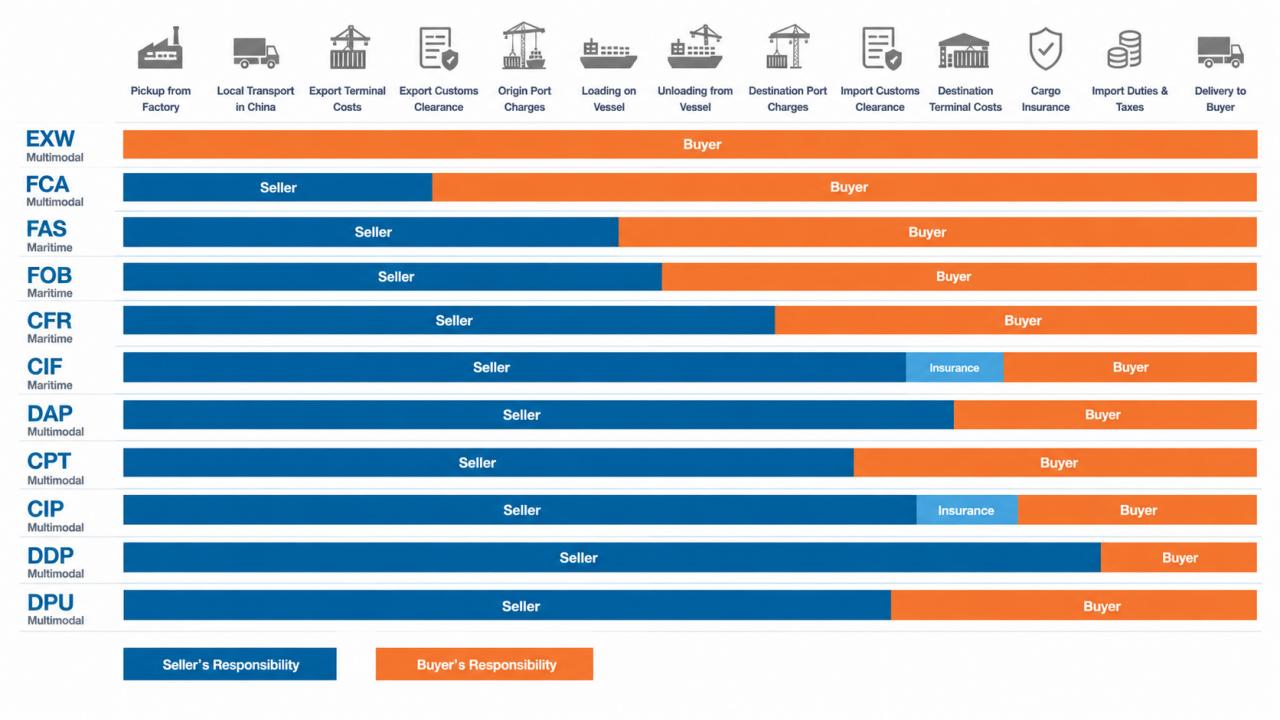
The table below gives you a quick overview of all 11 Incoterms 2020 rules, roughly moving from lower seller obligations to higher seller obligations.
| Incoterm | Transport Mode | Seller’s Main Responsibility | Buyer’s Main Responsibility | Risk Transfers |
| EXW | Any mode | Makes goods available at the agreed location | Almost all transportation and customs procedures after delivery | At seller’s premises |
| FCA | Any mode | Delivers goods to the agreed carrier and handles export clearance | Main transportation and import clearance | When goods are handed to the carrier |
| CPT | Any mode | Pays carriage to the named destination | Import clearance and related costs | When goods are handed to the first carrier |
| CIP | Any mode | Pays carriage and insurance to the named destination | Import clearance and related costs | When goods are handed to the first carrier |
| DAP | Any mode | Transports goods to the named destination | Import clearance and import duties | At the named destination |
| DPU | Any mode | Transports and unloads goods at the named destination | Import clearance and import duties | After unloading at the destination |
| DDP | Any mode | Transportation, import clearance, duties, and other delivery responsibilities | Mainly receiving the goods | At the named destination |
| FAS | Sea / inland waterway | Delivers goods alongside the vessel | Loading and all subsequent transportation | Alongside the vessel |
| FOB | Sea / inland waterway | Export clearance and loading goods on board | Main transportation and import clearance | When goods are loaded on board |
| CFR | Sea / inland waterway | Loads goods and pays ocean freight | Insurance and import clearance | When goods are loaded on board |
| CIF | Sea / inland waterway | Loads goods, pays ocean freight, and arranges insurance | Import clearance and related costs | When goods are loaded on board |
EXW — Ex Works
Under EXW, the seller makes the goods available at their factory or another agreed location. From there, you take responsibility for the rest of the shipment, including pickup, loading, export customs clearance, transportation, insurance, import clearance, duties, and final delivery.
If you have a reliable freight forwarder in China and can handle the export process, EXW can give you greater control over transportation.
FCA — Free Carrier
Under FCA, the seller delivers the goods to the carrier you designate at the agreed location and handles export customs clearance.
You do not need to arrange pickup directly from the factory, but you remain responsible for international transportation, import clearance, and destination charges. When you want the seller to assist with the Chinese export process, FCA can be more practical than EXW.
FAS — Free Alongside Ship
FAS is only used for sea and inland waterway transportation. The seller delivers the goods alongside the vessel at the port of shipment. From that point, loading, transportation, and insurance are your responsibility.
The loading stage is particularly important because the point at which the goods are placed on board determines when the risk transfers.
FOB — Free on Board
FOB is one of the most common Incoterms used in ocean freight from China. The seller delivers the goods to the port, completes export customs clearance, and loads the goods on board the vessel. Once the goods are on board, the risk transfers to you. You are then responsible for ocean freight, insurance, import customs clearance, and related costs.
If you have a freight forwarder in China and an import clearance team at destination, FOB can give you better control over transportation costs.
CFR — Cost and Freight
CFR is only used for sea and inland waterway transportation. The seller pays the freight to the destination port, but the risk transfers to you once the goods are loaded on board. You are responsible for arranging insurance.
CIF — Cost, Insurance and Freight
CIF is similar to CFR, but the seller is also required to arrange cargo insurance. The risk still transfers to you once the goods are loaded on board.
This term can reduce the amount of transportation work you need to arrange because the seller handles the freight and insurance. However, you have less control over the transportation cost and arrangements.
CPT — Carriage Paid To
Under CPT, the seller arranges and pays for transportation to the named destination. However, the risk transfers to you when the goods are handed over to the first carrier.
CIP — Carriage and Insurance Paid To
The seller arranges transportation, purchases insurance, and pays the relevant costs. Compared with CIF, CIP requires the seller to obtain broader insurance coverage under Incoterms 2020.
DAP — Delivered at Place
Under DAP, the seller transports the goods to the named destination, such as your warehouse or another agreed location. The seller bears the transportation costs and risks up to that point, while you are responsible for import customs clearance and import duties.
DPU — Delivered at Place Unloaded
DPU is similar to DAP, but the seller also has to unload the goods at the named destination. It is the only Incoterm under which the seller is specifically responsible for unloading the goods.
DDP — Delivered Duty Paid
DDP places the greatest level of responsibility on the seller and can be one of the most convenient options for the buyer.
DDP can reduce the amount of customs and logistics work you need to handle. It may be suitable if you are importing for the first time, have limited customs experience, or prefer to leave most logistics operations to the seller. However, the feasibility of DDP depends on the seller’s ability to legally handle import procedures in the destination country.
If you are comparing DAP and DDP, see our DDP vs DAP guide for a closer look at the differences in responsibilities, costs, and customs clearance.
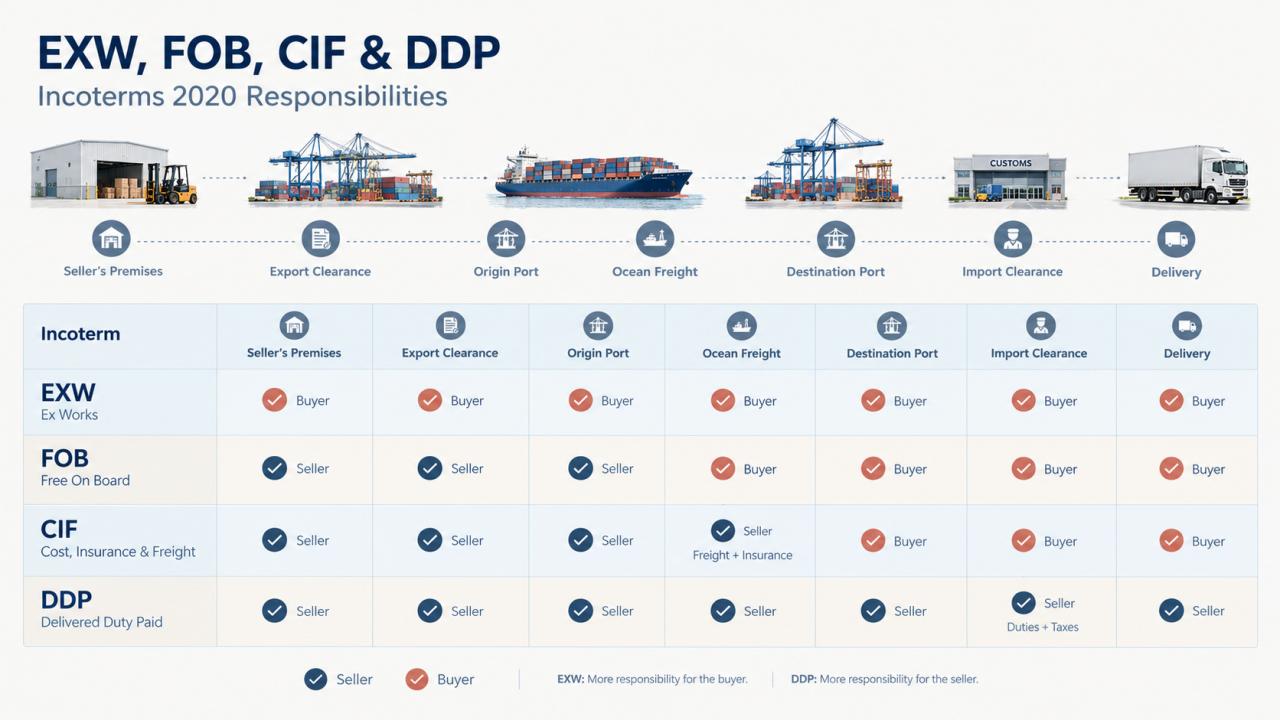
EXW vs FOB vs CIF vs DDP: Which Is Better for You?
| Item | EXW | FOB | CIF | DDP |
| Seller’s main responsibility | Makes goods available at the factory | Export clearance and loading on board | Export clearance, loading, ocean freight, and insurance | Almost the entire transportation chain |
| Buyer’s main responsibility | Most logistics processes | Main transportation and import procedures | Import clearance and destination costs | Mainly receiving the goods |
| Control over main transportation | High | High | Lower | Low |
| Import customs clearance | Buyer | Buyer | Buyer | Seller |
| Import duties | Buyer | Buyer | Buyer | Seller |
| Risk transfer | Seller’s premises | On board the vessel | On board the vessel | Named destination |
| More suitable for | Buyers with logistics resources in China | Buyers with a freight forwarder and import team | Buyers who want the seller to arrange main transportation | Buyers who want to reduce logistics operations |
- If you have your own freight forwarder and import team: FOB is worth considering. You can manage the international sea freight and have greater control over logistics costs.
- If you want the supplier to arrange the main ocean freight: CIF can be considered. However, destination charges and import customs clearance may still be your responsibility.
- If you do not have logistics resources in China: You can consider FCA or EXW + a China-based freight forwarder, depending on whether you need the supplier to assist with export procedures.
- If you do not have an import team at destination: You can consider DDP, but first confirm whether the service provider can legally and practically handle import clearance and related responsibilities in your destination country.
Incoterms for Shipping from China to Latin America
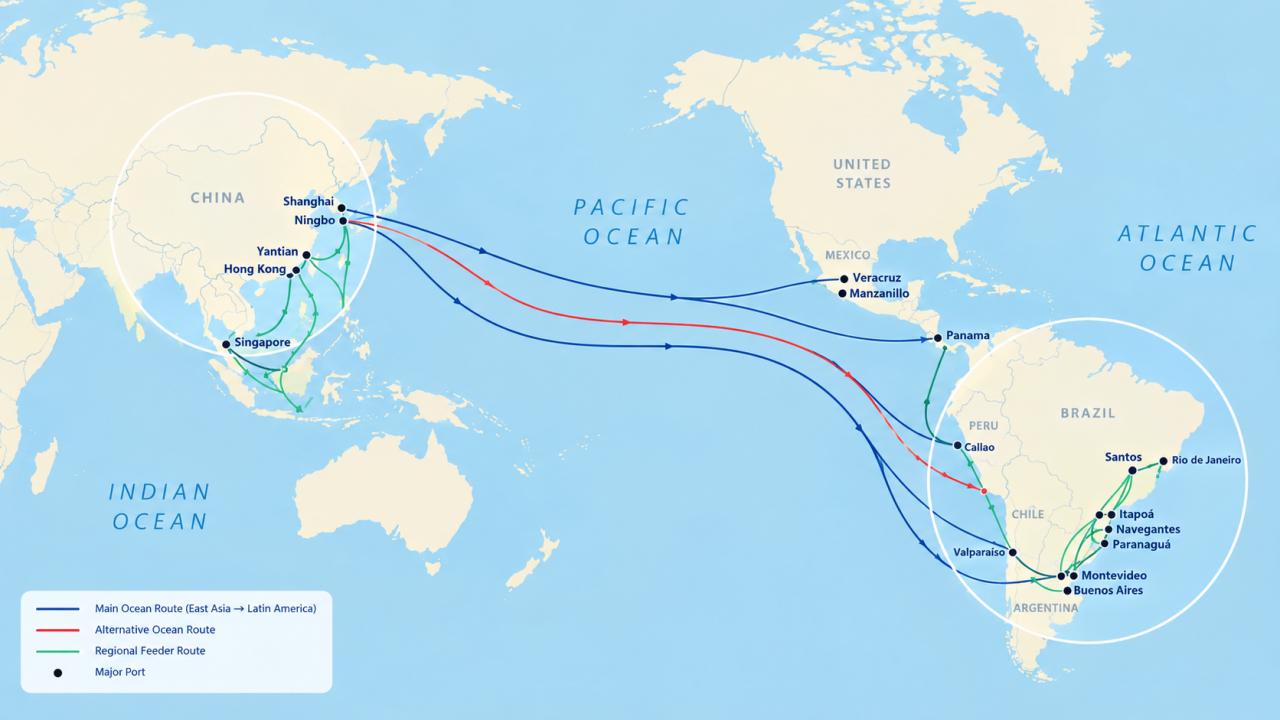
Import regulations, customs procedures, and tax requirements vary considerably across Latin American countries. When importing from China, you need to look beyond the supplier’s product price and consider who arranges international transportation, who handles customs clearance, who pays duties and taxes, and whether you have the local resources to manage the import process.
| Country | Key Factors When Choosing an Incoterm |
| Mexico | Importer of record, RFC, customs, and tax requirements |
| Brazil | RADAR, CNPJ, import registration, and complex tax environment |
| Peru | Import documents, HS codes, and customs requirements |
| Colombia | Import qualifications, customs clearance, and destination delivery |
| Chile | Tariff policies, certificates of origin, and customs clearance |
| Panama | Import clearance, destination delivery, and Free Zone / Colón Free Zone operations |
| Argentina | Import regulations, taxes, and changing policies |
Mexico and Brazil: Pay particular attention to the importer of record and local compliance requirements. If you are considering DDP, do not compare quotes alone. Confirm that the seller or logistics provider can legally handle import clearance and related responsibilities.
Peru and Colombia: Your choice of Incoterm can depend largely on your import capabilities and how much control you want over transportation. If you already have local import resources, FOB can allow you to arrange international transportation and destination customs clearance yourself. If you do not, DDP can reduce the amount of import-related work you need to handle.
Chile: Pay close attention to applicable tariff policies and certificates of origin. If your goods qualify for preferential treatment under a relevant trade agreement, confirming product eligibility and origin documentation in advance may provide better cost control than simply choosing a DDP quote.
Panama: When shipping from China to Panama, consider import clearance and final delivery requirements. For shipments involving the Colón Free Zone, the applicable customs and tax arrangements may depend on the final use and destination of the goods. FOB, CIF, and DDP can all be compared based on your import capabilities and logistics requirements.
Argentina: Pay particular attention to import regulations, taxes, and policy changes. If you choose DDP, confirm before placing the order that the service provider has established customs clearance experience and reliable local resources in Argentina.
Incoterms FAQ
Are Incoterms Legally Required?
Incoterms are not legally mandatory. However, once you incorporate a specific Incoterm into your sales contract, it becomes part of the contractual agreement between you and the seller.
For example, if your contract specifies “FOB under Incoterms 2020,” both parties should follow the responsibilities defined by that rule.
Do Incoterms Determine Cargo Ownership?
No. Incoterms define the allocation of costs, responsibilities, and risks between the buyer and seller. They do not determine when ownership of the goods transfers.
Ownership should be addressed separately in your sales contract.
Do Incoterms Determine Payment Terms?
No. Incoterms do not determine when or how you pay the seller.
Payment arrangements such as advance payment, letter of credit, or payment after shipment should be agreed separately in the sales contract.
Do Incoterms Include Insurance?
Only CIF and CIP require the seller to arrange cargo insurance.
Under CIF, the seller’s insurance obligation provides a lower level of coverage than the insurance required under CIP. CIP requires broader insurance coverage under Incoterms 2020.
Even when the seller has no insurance obligation under a particular Incoterm, you can still arrange your own cargo insurance based on the type of goods and transportation risks involved.
Can Incoterms Be Used for Air Freight?
Yes, but you need to choose an appropriate term.
The seven Incoterms designed for any mode of transport — EXW, FCA, CPT, CIP, DAP, DPU, and DDP — can be used for air freight.
The four terms designed specifically for sea and inland waterway transport — FAS, FOB, CFR, and CIF — should not be used for air freight.
Need Help Choosing the Right Incoterm?
Still unsure which Incoterm fits your shipment?
Tell us your product, destination country, and whether you have local import qualifications, and we can help you evaluate the appropriate term. We can also compare the estimated costs, responsibilities, and risks under different Incoterms so you can make a more informed shipping decision.